
Accurate information is not always enough
The regulation of environmental claims is sometimes presented as a simple matter of evidence: the company must be able to demonstrate that what it claims is true.
This interpretation is necessary, but insufficient.
A claim may be based on factually accurate information yet exaggerate the actual environmental significance of the element highlighted. It may concern a secondary product characteristic, a single stage of its life cycle or a limited part of its composition, while giving the impression of overall environmental performance.
“Is the information true?” But also: “Is the environmental benefit real and significant, and does its presentation remain proportionate to what can objectively be established?”
European guidance on unfair commercial practices states that a positive aspect should not be disproportionately highlighted when it is marginal or conceals other significant product impacts.
The EmpCo Directive strengthens this logic. It notably prohibits certain generic environmental claims when the suggested excellent environmental performance cannot be demonstrated.
The issue therefore concerns both the truthfulness of the information and the overall impression created for the consumer.
From wording to control of the promise
For brands, the first consequence of this development concerns the very way communications about products, services and the company are created.
An environmental claim can no longer be regarded as simple marketing wording validated at the end of the advertising-development process.
It is the visible part of a broader system: product characteristics, material choices, manufacturing processes, supplier information, environmental data, certifications, assessed scopes and decisions made by the company.
Its creation may involve several functions:
- Product and R&D;
- purchasing and supply chain;
- sustainability;
- quality and certification;
- legal and compliance;
- marketing and communication;
- senior management.
Communication must therefore be developed so that every claim results from a controlled process of creation, validation and dissemination.
This process cannot rely solely on a formal reading of the regulatory framework. It must enable the company to guarantee the truthfulness of the information communicated, assess the actual significance of the benefits presented and avoid creating a promise it cannot uphold.
A brand must not only be able to substantiate what it claims. It must also ensure that its communication promises no more than can be concluded from the product’s environmental reality.
A label does not remove the issue of the claim
Labels and certifications can be important sources of information and evidence. They can establish the conformity of a product, organisation or process with defined criteria.
But conformity with a standard and overall environmental performance are not equivalent.
Certification answers a specific question: does the product or company meet the requirements within the standard’s scope? It does not necessarily answer another question: what is the product’s overall environmental performance and how much significance should genuinely be attributed to the certified benefit?
The fact that a product is certified does not automatically make every communication based on that certification compliant.
The brand must still examine what is actually certified, the scope covered and what consumers may reasonably understand when they see the label or associated claim.
This vigilance also concerns standard owners.
When an owner defines, imposes or authorises claims intended for use on products or in the communications of certified companies, it should subject those messages to a requirement comparable to that expected of a company formulating its own claim.
It is not merely a matter of verifying compliance with the standard’s rules. The reality and significance of the stated benefit, the scope of the evidence and the proportionality between what is demonstrated and what the label leads consumers to understand must also be questioned.
Certification verifies conformity with a standard; it does not remove the need to verify the relevance of the environmental promise conveyed by the label.
The Higg MSI case: when data is not enough
The Norwegian Consumer Authority’s intervention concerning the use of the Higg Materials Sustainability Index in 2022 provides an important illustration.
The Higg MSI was designed to compare the environmental impacts of different materials and inform professional decisions. Results from this tool were subsequently used to create consumer-facing environmental communications about garments placed on the market.
The Norwegian authority considered that Norrøna’s communication based on Higg MSI data could be misleading. It also warned H&M that comparable use could breach the rules applicable to commercial practices.
Following this intervention, the Sustainable Apparel Coalition — now Cascale — suspended its global consumer transparency programme, temporarily removed the relevant seals and scorecards and commissioned an independent assessment of Higg MSI data and methodology.
The case does not mean that the tool had no value.
It shows that data relevant to technical decisions or material comparisons cannot necessarily be converted directly into a claim about the environmental performance of a finished product.
Between data and communication, the scope, methodological limitations and impression created must still be examined.
Environmental labelling changes the assessment framework
The display of the environmental cost of clothing introduced in France in October 2025 follows a different logic.
Certification establishes conformity with defined criteria. Environmental labelling seeks to model the impacts of a textile product reference throughout its life cycle.
The French methodology builds on the European Product Environmental Footprint approach and considers several impact categories. It also includes additions relating notably to garment durability, microfibre emissions and the export of used clothing outside Europe.
The two systems are therefore neither identical nor interchangeable.
A product may meet a standard’s requirements and nevertheless have a relatively high overall environmental cost. Conversely, environmental labelling does not necessarily cover all the qualitative, social or organisational dimensions considered by certain standards.
This coexistence requires brands to better understand what each tool measures and what it genuinely supports as a claim. It could also make discrepancies between the environmental value suggested by a label and the product’s calculated overall performance more visible.
The development of such systems should therefore increase attention paid to:
- the scope of standards;
- the actual environmental effectiveness of their criteria;
- the meaning of labels for consumers;
- consistency between the different pieces of information presented on the same product.
A governance issue
Environmental claims are no longer merely a matter of advertising copy or legal validation of a message.
They call into question the company’s ability to connect what it communicates with what it genuinely knows and controls.
This consistency must be maintained as products evolve, suppliers change, certificates are renewed, environmental data improves and regulatory requirements become more demanding.
A claim that is accurate when created may become inappropriate if its supporting information is not updated or if its presentation context changes.
Governance of the environmental promise therefore consists in maintaining a coherent relationship between:
- the reality of the product or organisation;
- the environmental benefit actually assessed;
- the available data and evidence;
- the scope of the claim;
- the perception likely to be created for the consumer.
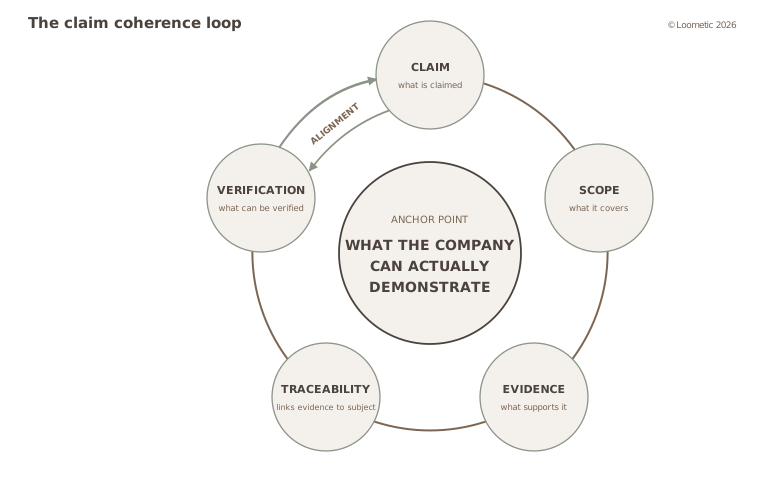
A concise representation of the dimensions to be kept consistent, without prejudging arrangements specific to each organisation.
The precise arrangements for this governance will depend on the organisation, its products, its value chain and the nature of its communications.
But its principle is becoming unavoidable:
Whether created by a brand or governed by a standard, an environmental claim must be assessed against its truthfulness, actual scope and the impression it creates.
Key takeaways
EmpCo does not merely change the words brands may use. It strengthens the requirement for consistency between their communications and the environmental reality they claim to represent.
Accurate evidence, a valid certificate or recognised data are not necessarily sufficient to guarantee that a claim will not be misleading.
For brands and standard owners alike, the issue now is to examine simultaneously:
- what is verified;
- what is genuinely improved;
- the significance of that improvement;
- what is communicated;
- what the consumer may understand from it.
The aim is therefore not to communicate more, but to build environmental promises that the company can objectively substantiate, keep proportionate and stand behind.