
Facts
European Union · adopted on 28 February 2024 · national measures to apply from 27 September 2026.
The European Directive (EU) 2024/825, officially referred to by the Commission as the Directive on Empowering Consumers for the Green Transition and abbreviated as ECGT in its FAQ, is also commonly called EmpCo. It strengthens consumer protection against misleading commercial practices relating in particular to environmental and social characteristics.
It notably amends Directive 2005/29/EC on unfair commercial practices. It was to be transposed by Member States by 27 March 2026 and provides for national provisions to apply from 27 September 2026.
Important developments include stronger regulation of generic environmental claims, sustainability labels, claims concerning future environmental performance, and the prohibition of certain climate-related communications based on offsetting.
Scope becomes decisive: an environmental characteristic limited to part of a product cannot be presented as concerning the whole product.
EmpCo does not establish prior third-party approval of every environmental claim. The Green Claims proposal was a separate legislative file. Recourse to a third party is therefore not a general obligation applicable to every claim.
Labels: a more profound change
For sustainability labels, the situation is different. For a private label, the scheme must notably be based on a certification system meeting the criteria defined by the Directive and include objective monitoring by a competent and independent third party.
In France, the DGCCRF clarified that the Directive does not, in itself, require this third party to be accredited by an accreditation body under ISO/IEC 17065. Such a requirement may nevertheless be specified by the standard owner. This is notably the case for GOTS and Textile Exchange standards, whose certification systems govern the accreditation and approval of certification bodies. These schemes provide a higher level of assurance than certifications subject to no accreditation. The DGCCRF will not establish a list of labels it considers compliant either: each label owner must assess its scheme against the applicable requirements.
For companies using labels, one point remains essential: responsibility for consumer communication does not disappear because a third-party label is used.
Certification can constitute robust evidence. It does not mean that any wording based on that certification may be used without further analysis. It remains necessary to verify what is certified, over what scope, and what the consumer is likely to understand.
Our observations
Market actors are already translating EmpCo into their practices. However, a recommendation, good practice or verification service offered by an organisation is not necessarily an obligation under the Directive. It is therefore essential to distinguish what the text requires from what market actors recommend.
Certification bodies and standard owners have already begun translating these new requirements into their systems.
Organisations are strengthening the evidence rationale
Control Union structures its approach around highly operational questions: what claims does the company use? What evidence supports those claims? Can that evidence be retrieved quickly? The approach connects claims, evidence, supplier information, certification and traceability. Certification appears as one possible way of strengthening the credibility of a statement, rather than as a universal obligation.
SGS takes an approach strongly focused on the burden of proof, transparency and independent verification. Bureau Veritas also emphasises evidence, verifiability and audit. These interpretations illustrate the importance of distinguishing what the law requires, what an actor recommends for risk management and the service it offers.
Textile standards are already evolving
Textile Exchange revised its Standards Claims Policy to take account of European regulatory developments. The updated version becomes mandatory on 27 September 2026. The former commitment claims were notably withdrawn pending a sufficiently credible verification approach.
OEKO-TEX announced a governance change in August 2026 intended notably to strengthen the demonstrable independence of its system in light of the new requirements applicable to sustainability labels.
These developments show that regulation concerning the fairness of consumer information is beginning to affect the rules applicable to claims, label governance, certification schemes and evidence systems.
Our analysis
For a textile or fashion company, the question should probably no longer simply be: “Do we have certification that allows us to communicate?”
The question instead becomes: “What exactly do we want to claim, and can we demonstrate exactly what that claim leads people to understand?”
A material may be certified without the entire product being certified. Certification may cover one environmental characteristic without covering other dimensions that consumers will spontaneously associate with terms such as “sustainable” or “responsible”. Data may be accurate without the way it is presented necessarily being fair.
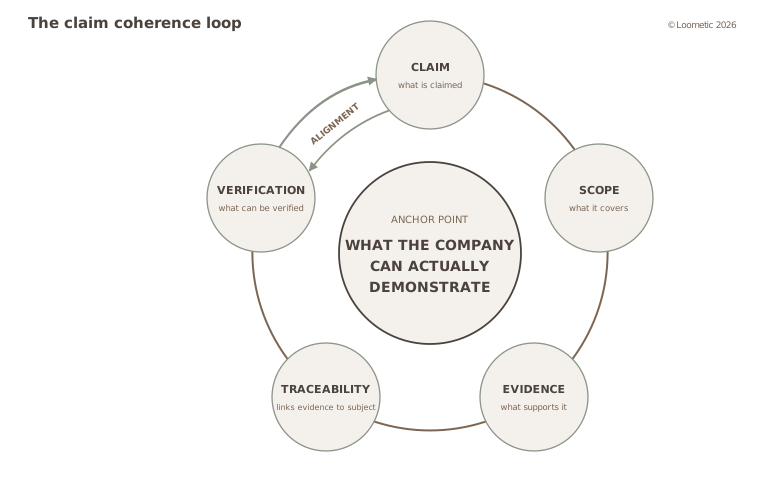
The chain is complete when the claim corresponds exactly to what verification establishes. Only then can it be communicated. Otherwise, the claim must be reworded, its scope reduced or the evidence supplemented.
Claims therefore become a matter of consistency across the chain of evidence. This extends beyond marketing and may involve Product & R&D, Purchasing & Supply Chain, Sustainability/CSR, Quality & Certification and Legal/Compliance.
EmpCo can therefore be read not only as communication regulation, but as an indicator of the maturity of companies’ data, evidence and governance systems.
And in France?
The situation in France requires an important qualification. During its webinar on 12 June 2026, the DGCCRF confirmed the delay in French transposition and indicated that the French framework would probably not be fully operational by the end of September.
This does not mean that no rules apply: France already has a framework governing misleading commercial practices and specific provisions on environmental claims. Companies therefore have an interest in preparing their communications, labels and, above all, the supporting evidence now.
European authorities in the CPC network have also adopted a common position concerning existing stock to support a consistent and proportionate application of the transition.
Key takeaways
EmpCo does not mean that every environmental claim must now be third-party certified. It does, however, strengthen the requirement for consistency between what is claimed, what that claim covers and what the company can genuinely demonstrate.
Prevent a statement from extending beyond the actual scope of the demonstrated benefit.
Identify the elements that actually support the statement.
Ensure traceability between the claim, the product concerned and the evidence used.
Certification can play an important role in this chain. But it is neither systematically the starting point nor automatically the end point.
Environmental claims & responsible communication
Understand the applicable framework and strengthen communications.
Explore the training course →